Tell us about the job
Takes about a minute. No obligation.
Gas combustion puts specific wear on water heaters: the burner orifice, the thermocouple, and the flue path all degrade in ways that electric resistance tanks never see. Utility gas heats more occupied homes in Santa Cruz County, California than any other fuel, at 57.3% (2020-2024 ACS 5-year). A contractor repairing a water heater in this county checks the venting path for back-drafting and inspects combustion air supply before touching the tank, because a sealed or restricted flue turns a straightforward repair into a safety job. Sediment buildup and anode rod condition still matter, but the gas train gets looked at first.
Water heaters in a house this old were not necessarily put in when the house was built, but the systems a contractor opens here regularly pre-date current part lines. Half the homes in Santa Cruz County, California were built in 1974 or earlier (2020-2024 ACS 5-year). A unit that has been running since before certain components were standardized may need a part that its manufacturer no longer stocks, which changes what the repair costs and whether it is worth doing. The contractor's first call, once the unit is open, is whether the replacement exists.
The Parts of a Water Heater a Contractor Checks First
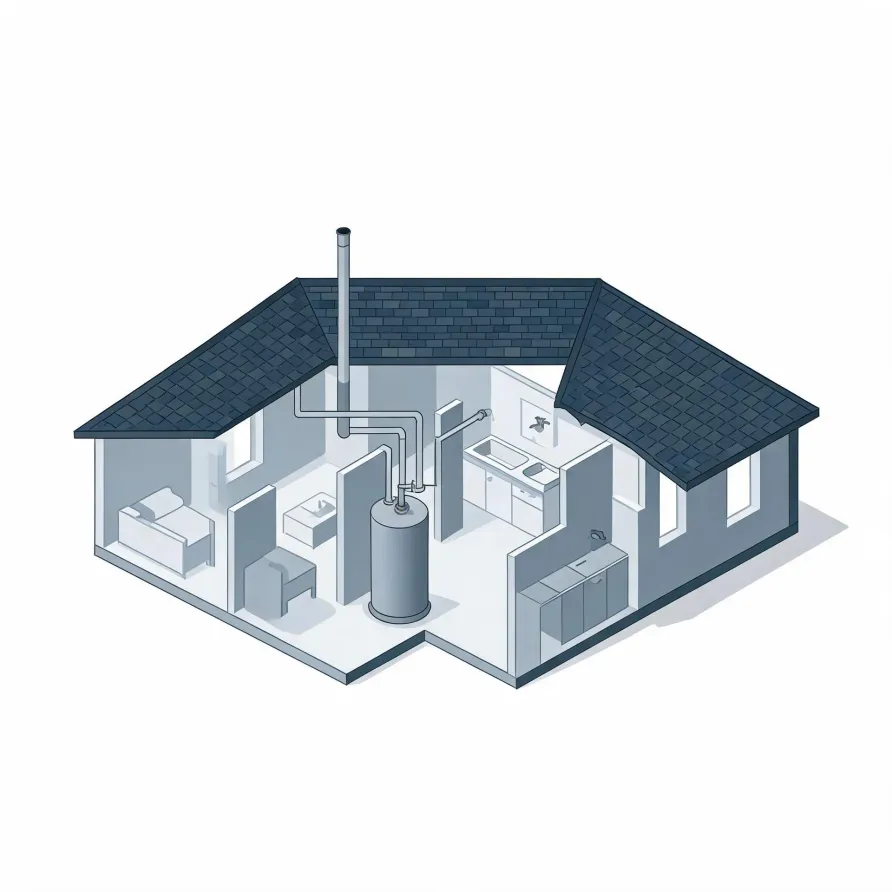
The tank is the piece a homeowner notices first, usually standing in a utility closet, basement, or garage. It holds the water and keeps it hot. The burner assembly or heating element sits at or near the base and is what actually raises the temperature. When hot water runs out fast or stops coming altogether, those two components are where a contractor starts.
The pressure relief valve mounts on the side of the tank and is built to open if pressure inside climbs too high. The anode rod runs down through the tank interior and slows corrosion from the inside out. Supply and discharge pipes connect at the top, and the thermostat sits against the tank wall, reading temperature and signaling the burner or element to fire.
The drawing shows the general layout of these components, and a licensed contractor determines which of them apply and what condition they are in for your specific setup.
Get matched in Santa Cruz CountySanta Cruz County, by the numbers
228 severe weather events were recorded in Santa Cruz County, California between 2015 and 2024.
NOAA National Centers for Environmental Information, Storm Events Database, bulk CSV export, events 2015-01-01 through 2024-12-31.Half the homes in Santa Cruz County, California were built in 1974 or earlier (2020-2024 ACS 5-year).
U.S. Census Bureau, 2020-2024 American Community Survey 5-Year EstimatesSanta Cruz County, California holds 106,977 housing units (2020-2024 ACS 5-year).
U.S. Census Bureau, 2020-2024 American Community Survey 5-Year EstimatesOwners occupy 59.9% of the occupied homes in Santa Cruz County, California (2020-2024 ACS 5-year).
U.S. Census Bureau, 2020-2024 American Community Survey 5-Year EstimatesWater Heater Repair Rules & Standards for Santa Cruz County, California1 codes, licenses, and standards
Licensing and Legal Requirements in Santa Cruz County, California
California requires a state contractor license: it is a misdemeanour to engage in the business of, or act in the capacity of, a contractor in California without one, unless the work is exempt.
Severe Weather Events in Santa Cruz County
Stress on a water heater compounds when outdoor conditions swing hard, because the unit works against whatever the environment throws at it. Repair demand in Santa Cruz County follows local weather patterns, which is why the history below is relevant here.
228 severe weather events, 2015–2024. Source: NOAA National Centers for Environmental Information, Storm Events Database.